The Art of Storytelling.
By: Aydan Ruddick.
A formulaic approach can be applied to nearly every aspect of our lives; this includes storytelling. Keeping your stories clear, concise, focused, and structured can ensure a robust finished product by the time it’s completed.

As with any successful project, all must plan stories precisely with a clear end goal in mind. Think of the process your account takes, like a long scenic drive to a beautiful crystal temple. During this drive, you’ll see a lot of exciting things; you’ll see abandoned houses and strange trees, multicolored rock faces, elegant waterfalls, and strange caves. All of these things you’re seeing populate your trip, holding your attention and building the anticipation for that fantastic end goal. Once you know where your story will end, you’ll learn how to populate it with incredible things.

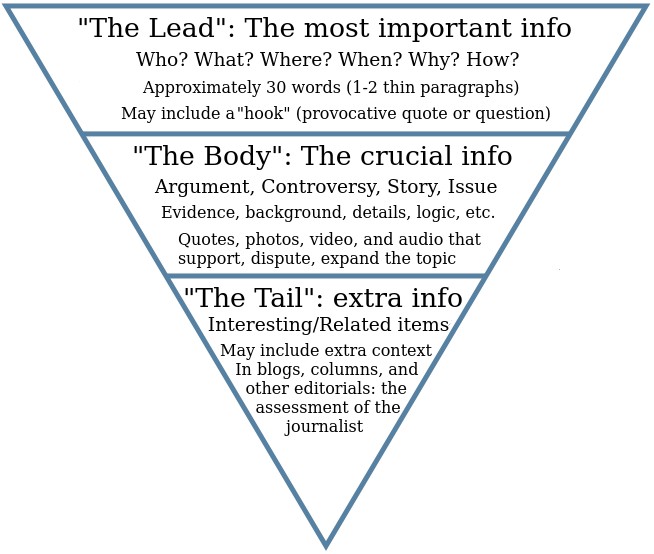
Every drive has to start somewhere, and if the beginning of that drive doesn’t intrigue you, then you’ll fall asleep on the road. This is the same for storytelling; to catch your audience’s attention, you need to start with a good “lead.” This lead is essential for holding an audience; its primary purpose is to reel them in tightly enough to build excitement towards the ending. A primary example of this would be the “inverted pyramid method,” which has you portray the most important information first to catch your audiences attention, filling the body with exciting news about your topic, and filling the end with the least polarizing information before revealing the conclusion to tie it all together. A diagram of the method will be showcased below.
Following these steps is a substantial base to have, but a few smaller-scale things are sure to build your story exponentially. The first being clarity and conciseness; adding too much “fluff” to an account can drive the audience away. The idea is to portray your points clearly and concisely to hold the reader’s attention and prevent yourself from going on miniature tangents that take away from the piece as a whole. The second is grammar and voice. Having grammatical or spelling errors can take away from the story and damage your writing credibility in the reader’s eyes. Picking your tone of voice is essential as well; you’ll always want to write in the active voice as opposed to passive voice. Active voice gives the reader the impression that you’re acting on the subject instead of having worked on it. You can achieve this by using action verbs such as “are,” and it will ultimately give your reader a more enjoyable experience.

By utilizing all these tips, you can rest assured that whatever you decide to fill your long scenic drive with will be interesting and hold your reader’s attention. Storytelling is a recipe; you just get to pick the ingredients.
 Aydans house